The method
How the coaching works.
This page sets out how the coaching works: the structure behind it, the materials it runs on, and who it has been built for.
The two Arabics
Standard and Gulf, side by side.
Two registers, both in daily use — Standard for documents and formal settings, Gulf for everyday conversation. Which one you work in depends on the route you take, and that is decided on the call.
Why it adds up
Arabic words arrive in families, not one at a time.
Most Arabic words are built from a three-letter root run through a fixed pattern. Learn the root k–t–b and you have not learned one word; you have the shape of a whole family — and the same is true of the roots that run through contracts, sites, tenders and meetings.
This is clearest in formal Arabic, and the full route is built on it. On the Tactical route the same families turn up inside the phrases you use at work.
- كَتَبَkatabahe wrote
- كِتَابkitaba book
- كَاتِبkatiba writer, a clerk
- مَكْتَبmaktaban office, a desk
- مَكْتَبَةmaktabaa library
The real constraint
It is the week that defeats people, not the grammar.
The class you miss twice is the class you quietly stop attending. Thirty minutes does not need a clear evening — it needs a gap you already have, before work, between meetings, or once the day is done.
A two-hour evening class — no room for it that evening.
- Your day, as it actually runs
- One 30-minute session
The method
Four moving parts. Nothing you have to organise yourself.
A 20-minute video call
Free, on Zoom, and there is nothing to prepare. I find out where you are starting from and what you need Arabic for — meetings, site visits, documents, or all three.
A syllabus, and the right track
There are two routes. The full route builds Modern Standard Arabic first, with a lot of formal dialogue work, and brings Gulf business Arabic in once your level carries it. The Tactical route is spoken Gulf Arabic on its own, for people who need to be understood at work now. The call decides which one you take.
30 minutes, consistently
How often you train is yours to set. The consistency is what compounds — not the length of any one sitting.
The plan moves with you
Your level, your goals and your workload change. The syllabus and the pace are adjusted as they do, rather than a fixed course being pushed to the end.
The principle underneath
You can only say what you have already taken in.
This is why sessions are not conversation practice alone. Reading and listening at the right level build the material; speaking and writing put it under pressure and show what is missing. The correction is the hinge — it names the gap, and the next block of input closes it.
Reading · Listening
levelled to where you actually are
Speaking · Writing
bounded by the input you have taken
corrections show which input you are missing
The plan already exists. The call decides where you enter it.
The materials
Nothing here is improvised.
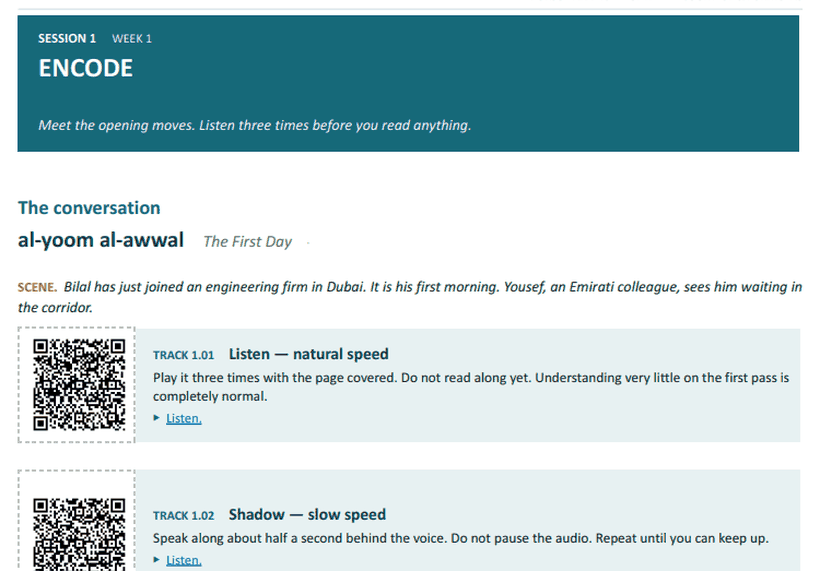
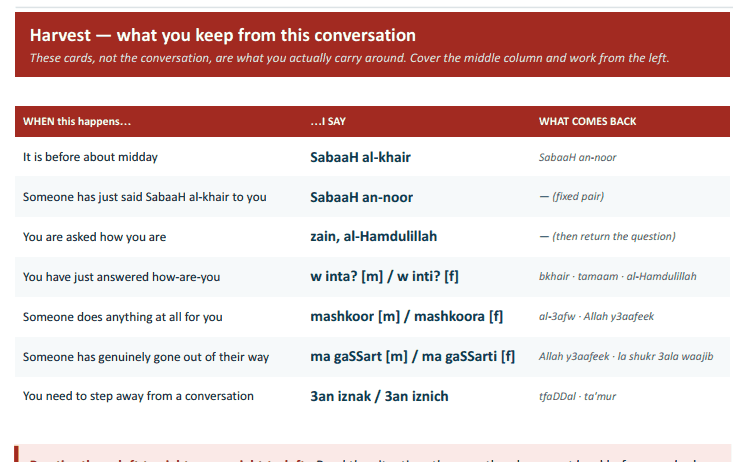
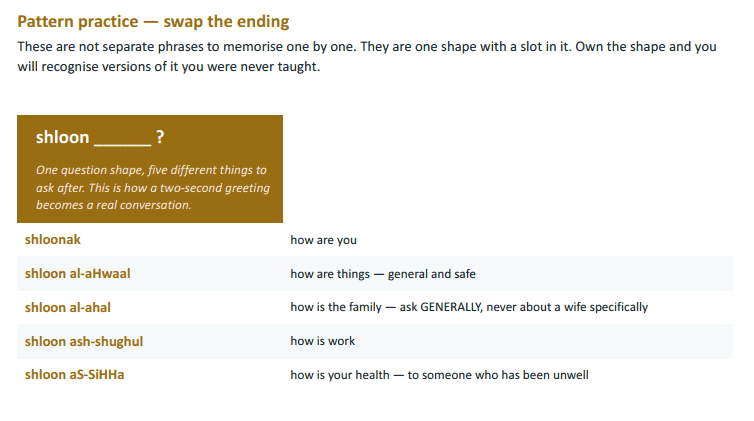
Sessions run on material built for this problem — levelled conversations with audio, situation cards drilled from the situation rather than from English, and diagrams for the sounds English never taught you.
Sounds English does not have
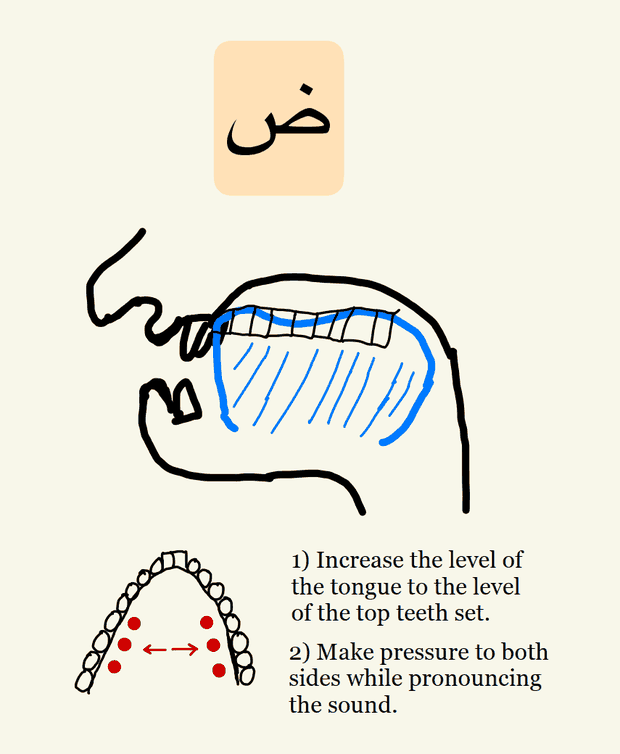
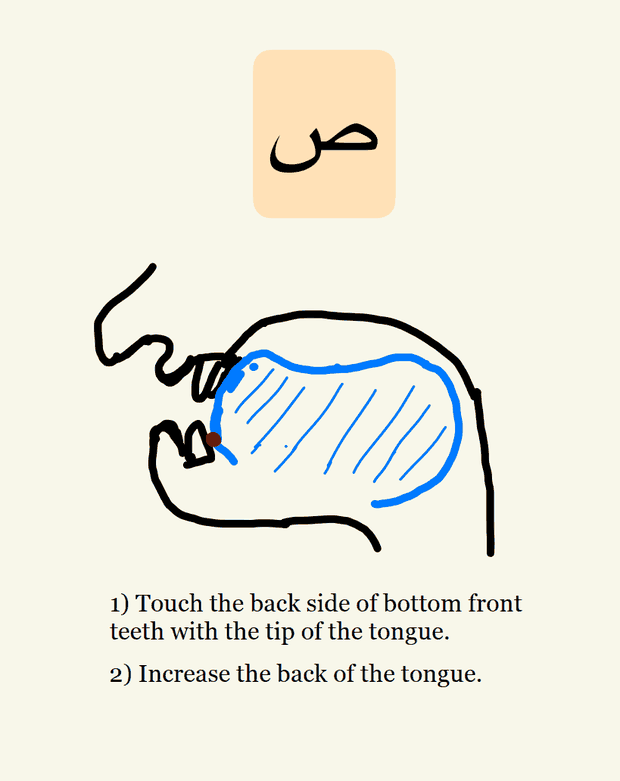
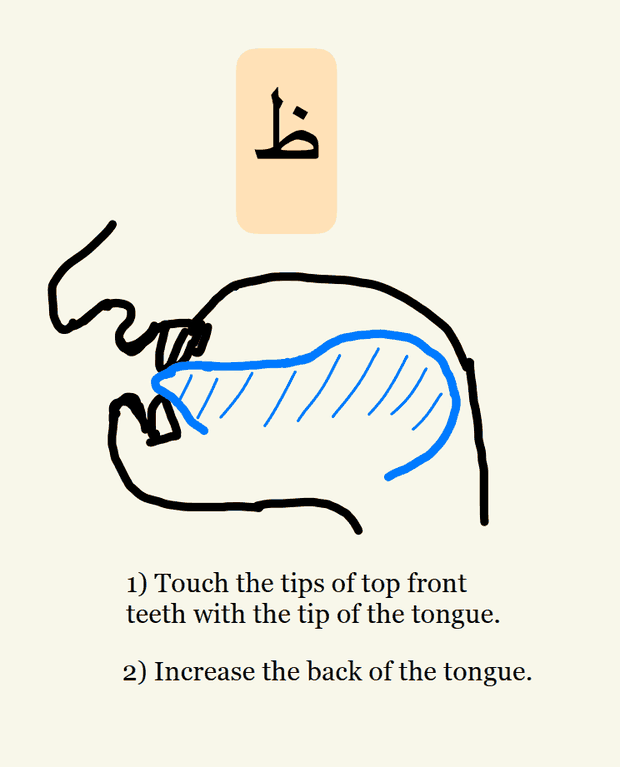
Inside Tactical Arabic — week one
Who I coach
Directors, founders and senior managers across the Gulf.
From manager and head-of level up to VP, partner and chief executive. Every place is one-to-one, so I work with a small number of people at a time. I do not publish client company names.
Technology & software
- Chief Executive OfficerIT services & consulting group
- Co-founder & CEOSoftware company
- Head of Consulting & ImplementationFood-delivery software
- Salesforce ManagerTechnology & internet platform
- Senior Category Manager, Fresh FoodGlobal software & q-commerce
Energy & industry
- Asst. Manager, LNG Marketing & BDState energy company, Qatar
- Head of Financial Planning & ReportingSteel & industrial holding
- Channel Sales ManagerElectrical & electronics manufacturing
Transport & aviation
- GM, Budget Planning & PerformanceNational airline, KSA
- Director of ITPublic transport operator, KSA
Consulting & procurement
- PrincipalGlobal strategy consulting firm
- Procurement & Logistics DirectorIT, communications & security
Student reviews
In their words.
“I highly recommend Abdulkadir to anyone looking to master the language for both personal and professional purposes. With a clear and patient teaching style, he makes learning Arabic engaging, structured, and practical. What sets him apart is his genuine dedication and encouragement, always ensuring I feel supported throughout the learning journey. An excellent tutor who truly delivers results!”
 Mr. ImranSite Manager at a well-known logistics company
“I am grateful to have had the opportunity to learn from Abdulkadir. From the very first lesson, it was clear that he is incredibly passionate about teaching Arabic and committed to my success. Abdulkader has a unique ability to explain complex concepts in a simple and engaging way, making even the most challenging topics feel approachable.”
 Mr. ShoebBusiness Development Manager
“After spending 10 years in the Middle East, I wanted to improve my Arabic speaking skills and gain more confidence. Abdulkadir’s friendly and innovative teaching methods, along with his dedication, helped me significantly. Thanks to his guidance, I now feel much more confident in my Arabic.”
 Mr. MuhammadChief Sales Consultant
“Abdulkadir’s Arabic course is a standout due to his innovative and student-centered teaching methods. He employs a communicative approach, emphasizing real-life conversational skills from the start, which helped me quickly grasp practical phrases for everyday use. He adapts lessons to individual needs, providing personalized feedback and encouraging active participation. This dynamic, immersive method made learning Arabic engaging and highly effective.”
“Abdulkadir’s passion for teaching, clear explanations, and innovative, student-centered methods make every lesson engaging and practical. He simplifies complex concepts and tailors each 1-to-1 session to my goals, providing personalized guidance that has greatly boosted my confidence. I especially enjoy the 30 minute micro-sessions which provide flexibility while maintaining consistency. He regularly asks for feedback to refine and improve the learning experience. His communicative, real-life approach has genuinely strengthened my Arabic.”

Your coach
Abdulkadir
Abdulkadir is an Arabic language specialist with experience teaching morphology, syntax and fluent communication in live online sessions. Trusted by various institutes, he now delivers concise, results-driven coaching to Gulf professionals, blending evidence-based pedagogy with real-world business scenarios.
He holds a degree in International Relations and is pursuing a master’s in Curriculum Design & Instruction — which is why this coaching runs on a designed syllabus with checkpoints rather than an open-ended conversation class. Every stage is built to move you toward the Arabic your role actually calls for.
- BA International Relations
- MA Curriculum Design & Instruction (in progress)
- Morphology & syntax
- Live online coaching
Pricing
One format. One-to-one.
Every plan is private coaching, online, built on 30-minute sessions. What changes is how often you train and how those minutes are grouped. The right rhythm for you is set on the strategy call.
$168/ month
That is four 30-minute sessions a month. Plans differ in how often you meet — more frequent rhythms cost more. The right one is set on the strategy call.
- One-to-one live sessions with me — never a substitute
- A designed syllabus with checkpoints, on the track that fits your goal
- Scheduling around Gulf working hours
- Month to month — no long-term contract
Questions
Before you book.
Do I need any Arabic to start?
No. Complete beginners are welcome, and so are people who have picked up some Arabic on site and want to improve it further. The strategy call exists to find out where you already stand.
Which Arabic will I learn?
There are two routes, and the strategy call decides which one fits you.
The full route. If you already read the alphabet, you start with Modern Standard Arabic — the structure everything else rests on — and from around B1, Gulf business spoken Arabic runs alongside it. Beginners can take this same route from the very start; it is the longer road, and it is the one that ends in real command of the language.
Tactical Arabic. If you need to be understood at work quickly, this route covers around 600 of the phrases used most in the Gulf, in roughly 170 hours. It is spoken Gulf Arabic for real situations, not a shortened version of the full course.
How do the sessions work?
Live, online and one-to-one. The default unit is 30 minutes, and that is what makes sessions survive a busy week — but they can be combined into longer sittings when your diary allows. You choose how many sessions a month, and the schedule is set with you.
I travel constantly. Is that a problem?
It is the reason the sessions are 30 minutes. A short, fixed slot fits around a travel week instead of competing with it. Your times are agreed at the start and kept — a half hour you protect is worth far more than one that moves every week.
How long until I can hold a conversation?
Honestly, it depends on how often you train and what “a conversation” means for your role. That is exactly what the strategy call is for — you will get a straight answer based on your level, not a marketing number.
How do I pay?
After the strategy call, once you decide to go ahead, you and I settle on the plan and the rhythm that fits your week. The monthly fee is then transferred directly and your sessions are scheduled. It is month to month — no contract, no lock-in — and you can change how often you train as your workload changes.
Nothing to prepare. Twenty minutes on Zoom: your level, your goal, a plan.